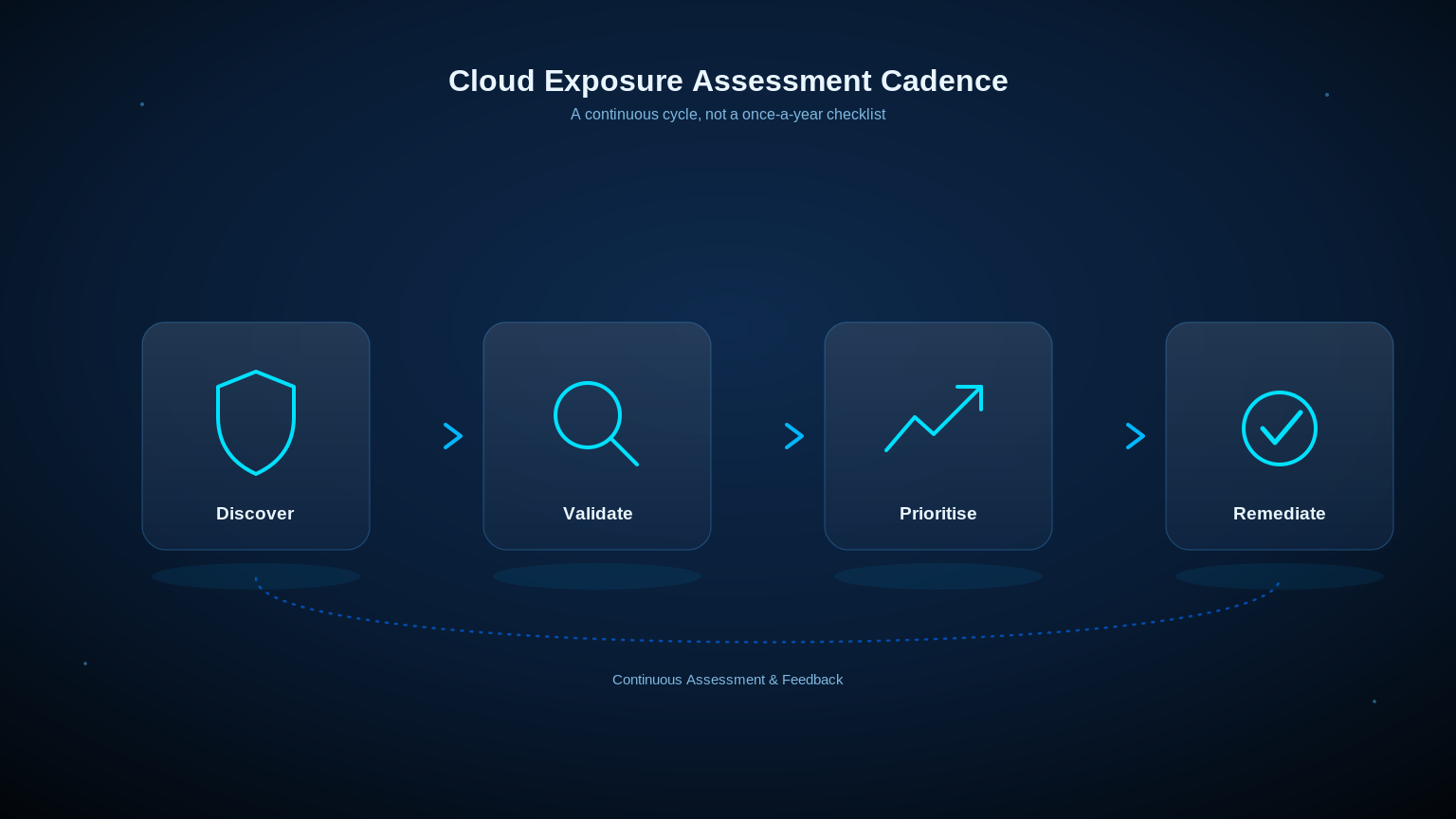
Security leaders rarely ask whether they should assess cloud exposure. They ask how often — which is really a question about cloud exposure assessment frequency, and whether it’s keeping pace with how fast your environment is actually changing.
Get the frequency wrong in either direction and you pay for it. Assess too rarely and you’re managing risk based on a snapshot that stopped being accurate weeks ago. Assess too often without a clear process and you generate more reports than any team can act on.
What Actually Changes Between Assessments
A cloud environment doesn’t sit still between review cycles. New workloads go live. Permissions get granted for a project and never revoked. Storage buckets get spun up for a one-off migration and stay exposed long after. Third-party integrations are added to support a new tool.
None of this shows up as a single dramatic event. It accumulates. That’s exactly why cloud exposure management has become a distinct discipline rather than a line item inside a broader security review — the risk isn’t static enough for a once-a-year checklist to keep up with it.
Why Annual and Quarterly Cycles Fall Short
Annual assessments made sense when infrastructure changed slowly and deployments went through lengthy change control. That’s not how most cloud environments operate now. A quarterly review already covers three months of unreviewed change by the time the report lands on your desk — and a lot can go wrong with excessive IAM permissions or a forgotten development environment in that window.
The deeper issue isn’t the calendar. It’s what a point-in-time cloud security assessment can and can’t tell you. It can confirm your posture on the day it ran. It can’t tell you whether a new exposure introduced the following week is more or less dangerous than the ones already on your remediation list. Without a way to track how exposure changes over time, every assessment starts from zero.
Setting the Right Cloud Exposure Assessment Frequency
There’s no universal number that fits every organisation, but there is a useful principle: assessment frequency should track your rate of infrastructure change, not an arbitrary compliance calendar.
A few signals worth using to set your cadence:
- Deployment velocity. Teams shipping new cloud services weekly need far tighter review cycles than one shipping quarterly.
- Identity and access changes. A spike in new roles, service accounts, or permission grants is a reasonable trigger for an ad hoc review, not just the next scheduled one.
- Prior findings. If your last review uncovered cloud misconfiguration risk tied to a specific team or platform, that area warrants a shorter recheck interval than the rest of the estate.
- Third-party and vendor changes. New integrations expand your attack surface the moment they’re connected, not on your next audit date.
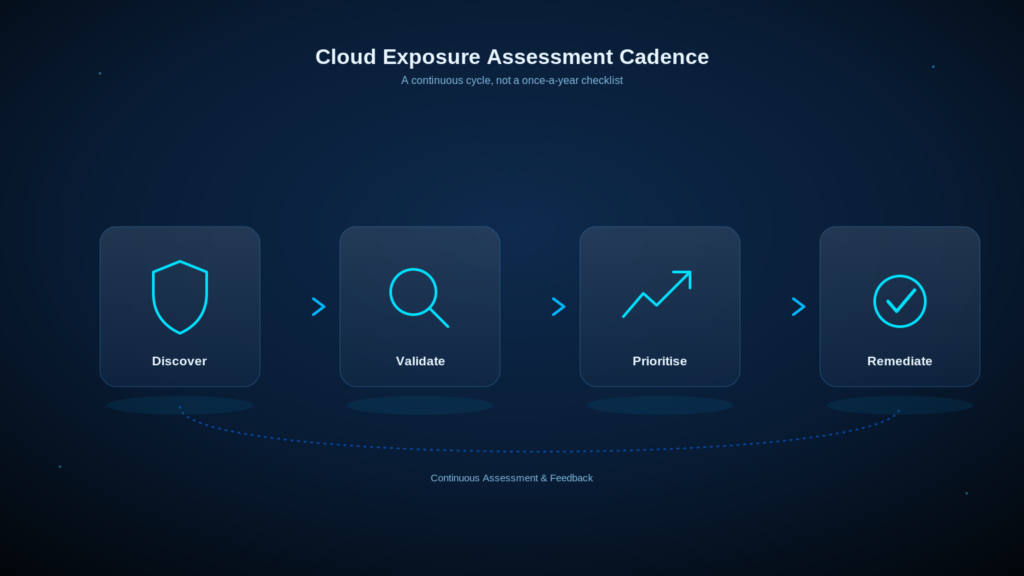
Organisations that treat these as ongoing signals — rather than waiting for the next entry in a compliance calendar — tend to land on continuous or near-continuous validation rather than a fixed quarterly or annual model. That’s a meaningful shift in operating model, not just a shorter interval on the same process.
What Every Cloud Exposure Assessment Should Deliver
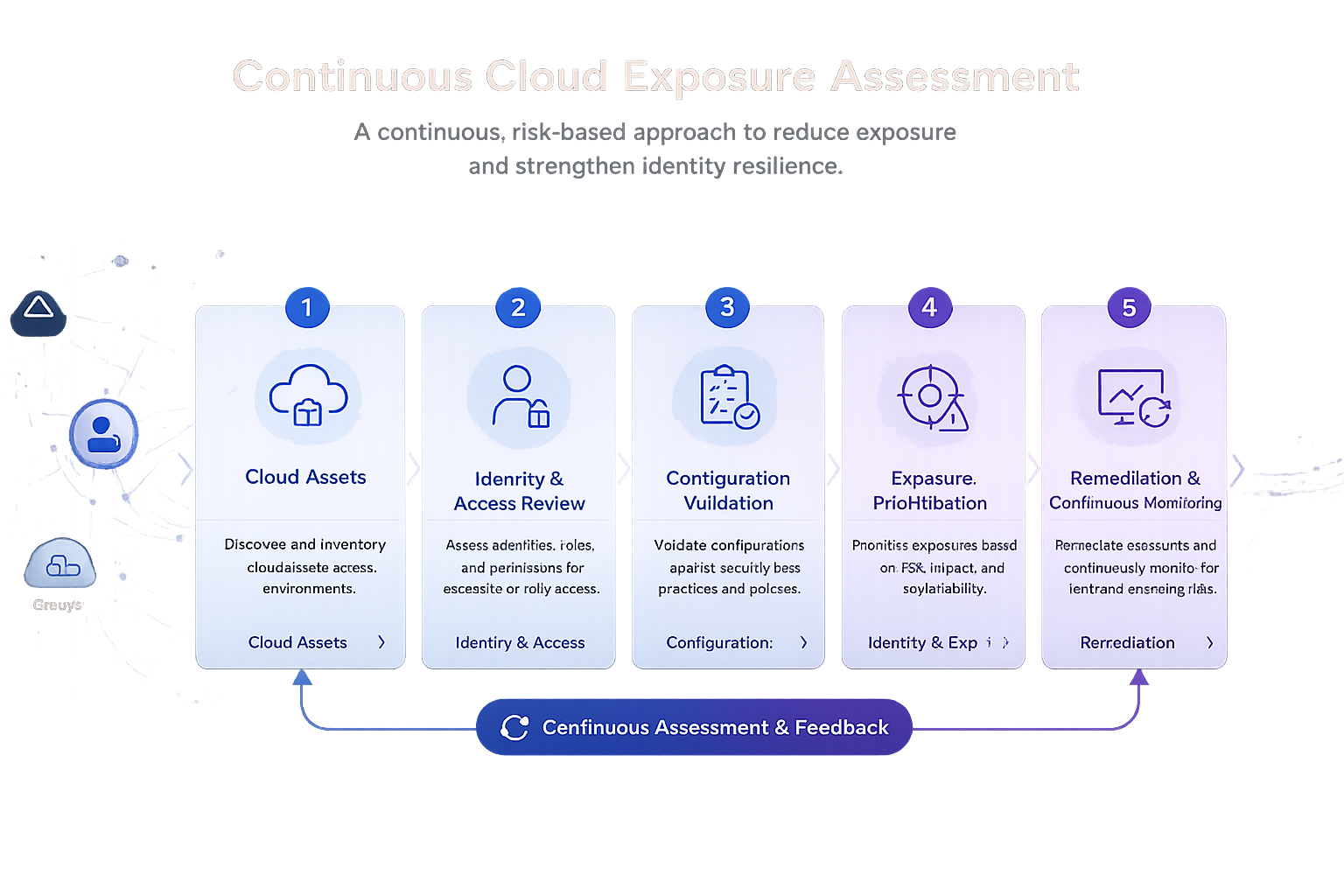
Regardless of how often you run one, a cloud exposure assessment should answer the same core questions on each pass: which assets are genuinely exposed, which identities carry excessive access, which misconfigurations create real exploitable risk rather than cosmetic findings, and how exposure has trended since the last review. Many of these exposures trace back to identity permissions rather than infrastructure itself, which is part of why identity in cloud security keeps surfacing as a recurring theme across cloud incidents.
If an assessment can’t show you the trend line — improving, worsening, or flat — it’s only answering half the question. NIST’s guidance on continuous monitoring (SP 800-137) makes a similar point for a reason: security effectiveness is best understood as a pattern over time, not a single measurement.
What Changes After the Assessment Runs
The value of a cloud exposure assessment shows up in what happens next, not in the report itself. A well-run assessment should leave your team with a short, prioritised list of exploitable exposures rather than a long list of findings ranked by severity alone. It should tell you whether remediation from the last cycle actually reduced risk, or whether the same issues resurfaced under a different name. And it should give you a defensible answer when a board or auditor asks how current your cloud risk picture is.
That’s a different outcome than “we passed our annual review.” It’s an operating model where exposure is tracked continuously enough that nothing sits unaddressed for months at a time.
Turning Cadence Into a Repeatable Process
Getting cloud exposure assessment frequency right isn’t about picking a number and defending it. It’s about building a process that adjusts to how fast your cloud environment actually changes, and that gives you a trend line instead of a single data point each time it runs.
CyberDNA’s Cloud Exposure Assessment is built around that model — continuous validation, prioritised on exploitability, with a clear before-and-after view of your cloud risk posture. If your last cloud review already feels out of date, that’s usually the clearest sign your current cadence isn’t matching your environment anymore.
Book a Cloud Exposure Assessment: Here